
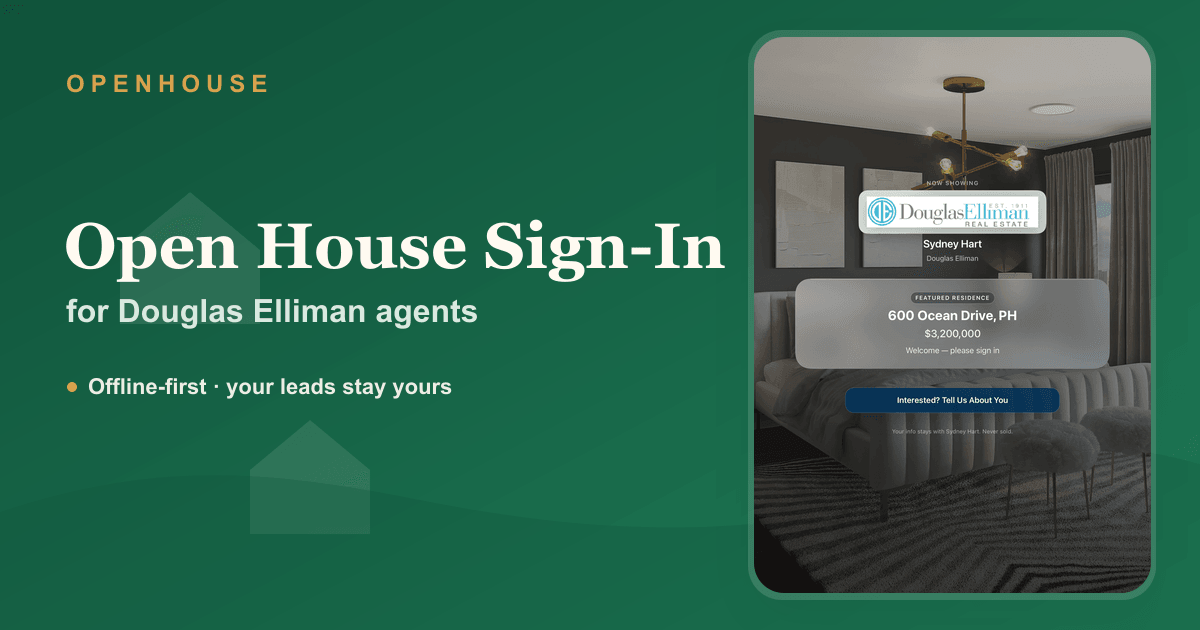
A Douglas Elliman open house is rarely a numbers game, it's a handful of qualified people walking through a listing that deserves to be handled with care. The way you greet them, and the way you handle their information afterward, is part of the brand. A Douglas Elliman open house sign-in sheet that lives on your iPad lets you capture every visitor cleanly and discreetly, qualify them without an interrogation, and keep their details exactly where they belong: with you.
OpenHouse is an independent app, not a Douglas Elliman product. But it was built around a principle luxury agents already live by, discretion is not a feature, it's the whole job, and it happens to fit the showings where that matters most.
Discretion by architecture, not by policy
Most sign-in tools are cloud services: the visitor's name and number travel to a vendor's servers, sometimes to a paired lender, and you take their privacy promise on faith. OpenHouse takes a different path. It makes zero network calls. Every sign-in is written to the iPad in front of you and stays on the device until you decide to export it. There is no account, no backend, and no second audience for your client's data. For a buyer who guards their identity, and the seller who expects you to guard it, that isn't a nice-to-have.
A sign-in that fits the room
Hand a stranger your iPad in a $6M townhouse and you don't want them thumbing through your photos or reading the last visitor's number off the screen. Built-in kiosk mode locks the device to one quiet sign-in screen, and each visitor sees only their own. Add your headshot, your team mark, and a single welcome line, and the experience reads as part of the showing rather than an afterthought taped to the entry table.
Qualify without an interrogation
Not everyone who tours a trophy property is a buyer, and you usually know which is which within a minute. OpenHouse lets you quietly tag each visitor, represented buyer, unrepresented and serious, a neighbor, an investor, so the follow-up list practically sorts itself. For the broader picture of what these tools should do, the open house sign-in app buyer's guide and our best open house apps list lay out the honest landscape, ours included.
Disclosures that hold up when the numbers are large
When a transaction is serious, what a visitor agreed to at the door matters. OpenHouse can present an agency or buyer-representation disclosure before sign-in and capture a signature, recording acceptance with a timestamp on each lead. If you want the legal grounding, our guide to buyer-agency disclosure at open houses is a useful primer.
Your leads, then your system
OpenHouse isn't a CRM and doesn't pretend to be. It captures and qualifies at the door, then hands leads off the way you prefer, CSV, Contacts, vCard, a polished PDF summary for the seller, or a share-to-CRM handoff into whatever platform your team runs. From there your follow-up takes over. The app's job ends the moment the lead is safely yours.
OpenHouse vs. a paper sheet on a luxury listing
| Paper sign-in sheet | OpenHouse | |
|---|---|---|
| Discretion between visitors | ❌ the list is visible to everyone | ✅ a private screen for each |
| Client data stays off the cloud | ✅ but illegible and slow | ✅ on-device, nothing transmitted |
| Works with no signal | ✅ | ✅ fully on-device |
| Buyer qualification | ❌ | ✅ represented / serious / neighbor / investor |
| Signed disclosure with timestamp | ❌ | ✅ |
| Seller-ready summary | ❌ | ✅ PDF you can share after the showing |
| No retyping on Monday | ❌ | ✅ export clean to your CRM |
For Douglas Elliman agents who run luxury showings
If most of your business is high-value listings, the luxury real estate workflow is worth a read, it covers how to keep a polished, private door experience without losing a single qualified lead to a clipboard or a connection.
The honest caveats: OpenHouse is a paid app, it's iOS and iPadOS only, and it isn't a marketing suite, no drip campaigns, no microsites. What it does is capture every visitor discreetly, qualify them, keep the data yours, and hand it off clean. If that's the standard your listings demand, try it free for a month and run it at one showing before a marquee open house.
Frequently asked questions
Is there an open house sign-in app suited to Douglas Elliman's luxury listings?
Yes. OpenHouse is an iPad and iPhone sign-in app built for agents who care about discretion. It captures each visitor at the door, qualifies them quietly, and keeps every lead on your device, nothing is routed to a vendor cloud or a paired lender. It is an independent app and is not provided by or affiliated with Douglas Elliman.
Why does on-device data matter for high-value listings?
High-net-worth buyers are protective of their contact details, and so are the sellers who trust you with a marquee listing. OpenHouse makes zero network calls and stores every sign-in locally, so a visitor's information never leaves your iPad until you choose to export it. There is no third party in the middle and no lead data quietly funding the app.
Does the kiosk look elegant, or like a generic form?
You can add your headshot or team mark and a short welcome line, and lock the iPad to a single clean sign-in screen with built-in kiosk mode. It reads as a considered part of the showing, not a clipboard taped to a console table.
Can visitors acknowledge a disclosure before signing in?
Yes. You can present an agency or buyer-representation disclosure before sign-in and capture a signature, with the acceptance and a timestamp recorded on each lead, useful documentation when the transaction sizes are serious.
Does it work in a townhouse or new-development unit with no signal?
Yes. Because OpenHouse is fully on-device, a stone-walled townhouse or an unfinished penthouse with no service behaves exactly like a connected listing. Nothing waits on a network, so no lead is lost to a dead zone.
OpenHouse is an independent application and is not affiliated with, endorsed by, or sponsored by Douglas Elliman Real Estate. "Douglas Elliman" and its logo are trademarks of their respective owner and are used here only to describe the agents this page is written for.