
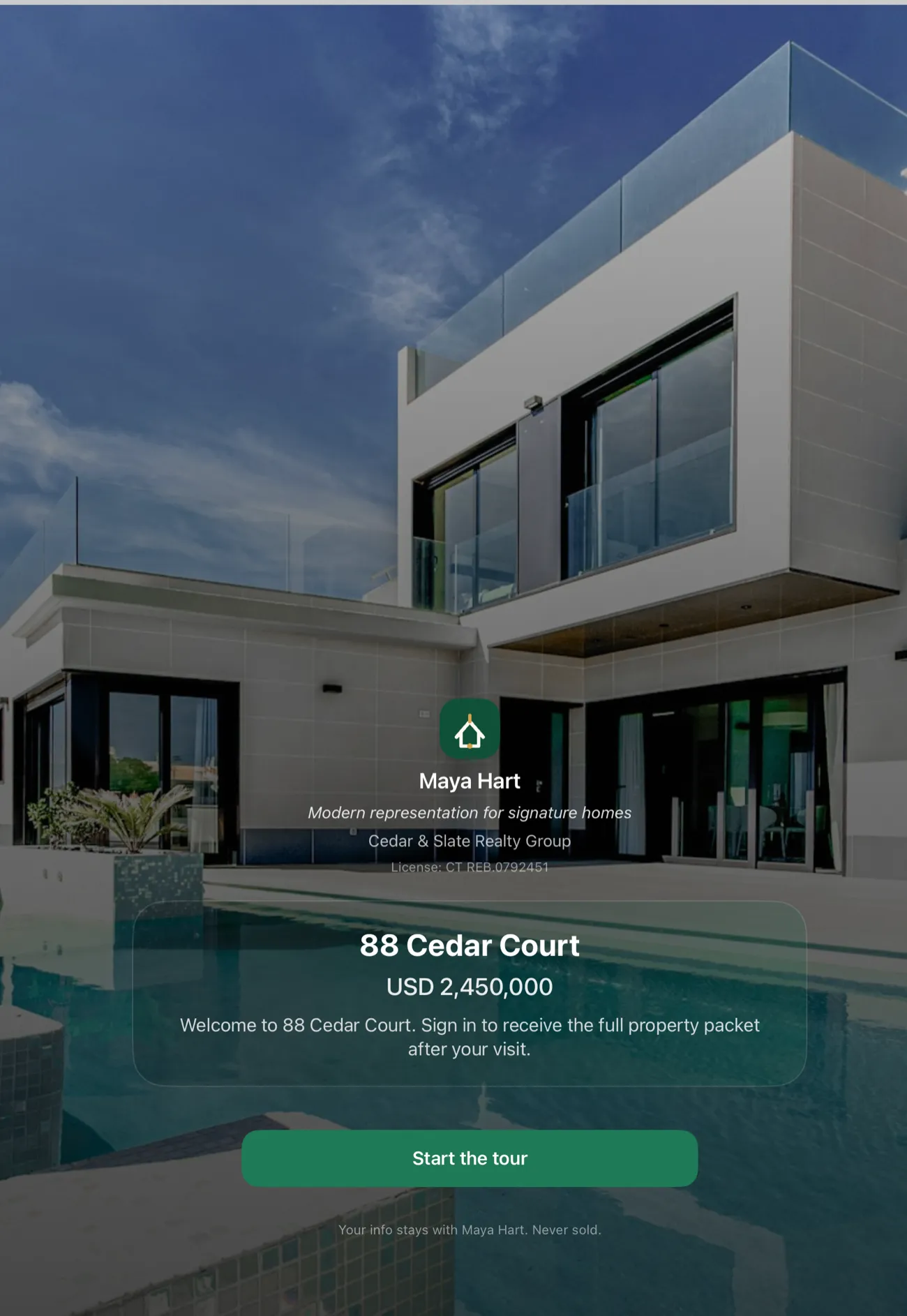
Open house app for listing agents starts from a fact the buyer-capture pitch skips over: at your open house, the entry table is part of the listing presentation. It sits inside a home you were hired to sell, in front of the seller's prospective buyers, and whatever is on it reflects on you and on the seller. A clipboard with smeared handwriting says one thing about how you run a listing. A tablet running a lender's advertisement says another. The listing agent's job at an open house is not only to collect leads; it is to present the property professionally, capture the disclosures and consent you are now expected to get at the door, and come back to the seller with a clear account of what happened. This page is about what a sign-in app owes that side of the work.
The National Association of REALTORS covers the listing agent's duties and the recent changes to buyer representation in its research and statistics. The short version for open house day: you are representing the seller, you are meeting buyers who may or may not have their own agent, and the paperwork around that has gotten stricter. A good sign-in app should make those obligations easier to meet, not add a device you have to babysit.
The entry table represents the listing, not the app vendor
The first thing a seller's buyer sees when they walk in is your sign-in setup. If it looks like a garage-sale ledger, that is the impression the listing starts with. If it flashes a mortgage ad, the buyer's first read of your professionalism is that someone paid to be there.
Single-screen sign-in is built to disappear into a clean presentation. Name, email, and phone on one screen, no scrolling, no account creation, and no vendor branding on the form. A visitor fills three fields and is done. You can add a custom question or two when the listing calls for it, and they sit on the same screen instead of forcing a second page. Pair the iPad with Apple's Guided Access and PIN-locked kiosk mode, and the tablet stays on the sign-in screen while you show the primary bedroom, so a curious visitor cannot wander into your photos or email.
What is deliberately absent matters as much as what is there. OpenHouse's private lead capture keeps visitor data on the device by default, with no lender on the form and nothing sold. It is worth understanding how the free alternatives pay for themselves here. Curb Hero is a well-built and popular free app, and it funds that with lender co-marketing. Curb Hero's own help documentation explains that a default lender can be assigned to your listings and that a visitor who opts into mortgage questions has their information shared with that lender. If a lender partnership is part of your business, that is a feature. On a seller's listing, though, it means a third party you did not introduce is standing in the middle of the buyer's first contact, on a form that carries the seller's address. That is a choice a listing agent should make on purpose, not inherit from a free download.
Disclosures and consent, captured at the door
The part of open house duty that has changed the most is representation. A listing agent works for the seller. A buyer walking in may already have an agent, may be unrepresented, and may not understand the difference. Getting the disclosure and consent right at the door is now table stakes, and doing it on a separate paper form you have to remember to hand over is where it slips.
OpenHouse captures the disclosure moment as part of sign-in. Disclosure capture records buyer-agency and non-agency disclosures and a consent checkbox before the visitor finishes signing in, so every person who walks through sees the same wording and the record lands attached to the lead instead of on a loose sheet in a folder. There is no separate step to forget and no inconsistency between the buyer you disclosed to at noon and the one at three.
For the specifics of what to present and when, the buyer-agency disclosure at an open house guide walks through the representation conversation for a listing agent, and the open house non-agency disclosure guide covers the case where you are not representing the visitor at all. The app does not give legal advice, and your brokerage's required forms and wording still govern; what it does is put the capture in the one place every visitor already passes through, so the disclosure is consistent and recorded rather than improvised.
The seller report that proves the open house worked
Here is the deliverable a buyer-capture app forgets and a listing agent lives on: the report you owe the seller after the event. The seller wants to know the open house did something. How many people came, when the traffic peaked, how interested they were, and what they said about the house, especially the price.
OpenHouse generates a seller report straight from the sign-in data as a clean PDF: visitor count, the represented-versus-unrepresented buyer share, interest levels, and feedback. You are not reconstructing Saturday afternoon from memory or squinting at a paper sheet on Monday. You hand the seller a document that looks like the work of someone who runs listings for a living.
That report also does quiet strategic work. When the feedback keeps circling the same objection, the kitchen, the street noise, the price, you have written evidence for the conversation that is otherwise your word against the seller's hope. The represented-versus-unrepresented share tells you whether the marketing reached fresh buyers or people who had already toured with their own agent, which is the honest read on how the listing is actually being found. A seller who gets a real report after every showing is a seller who renews the listing and refers you. This is the single feature most likely to make a listing agent look better to the person who hired them.
Qualifying buyers without the clipboard interrogation
A listing agent needs to know who is serious, but standing at the door running a buyer through twenty questions is both awkward and bad for the seller's showing. The answer is to move the qualifying onto the form the visitor is already filling out.
The single-screen sign-in takes optional custom questions: representation status, timeline, financing, and an open feedback field. The visitor answers them in the same few seconds it takes to sign in, so you learn whether this is a pre-approved buyer three weeks from an offer or a neighbor comparing finishes, without an interview at the entry table. Those answers travel with the lead into your follow-up and into the seller report, so the interest levels in that PDF are grounded in what buyers actually told you rather than a vibe. It is qualification that happens by design instead of by cornering people.
Offline reliability at a vacant listing
Listing agents draw the properties most likely to have no signal: the vacant house between owners, the new-construction unit where service was never turned on, the rural listing, the high-rise with dead elevator reception. Those are exactly the venues where an app that needs a connection to save a sign-in becomes a liability at the worst possible moment.
Offline lead capture runs every sign-in on the device itself, with zero network calls during the event. A four-hour open house at a vacant listing with no Wi-Fi and no cell signal captures every visitor exactly the way a connected one does. There is no sync bar to watch, no spinner while a buyer waits, and no chance that the record you needed for the seller report quietly failed to save. When the property is empty and you are the only person there, connectivity is not a variable you want to depend on in front of a buyer.
Your seller's buyers stay yours
The people who sign in at your listing are your leads and, by extension, part of your relationship with the seller. Where they end up matters. OpenHouse sends open house leads into the CRM you already run: Follow Up Boss, HubSpot, BoldTrail (kvCORE), Lofty, and Sierra Interactive receive them on their own after each event, and lead export to CRM also covers CSV, vCard, and Apple Contacts for any other tool. Nothing is held in a vendor's pool, and nothing is sold. If a listing agent ever changes tools, the leads leave as a plain file, not a hostage.
That portability is also the safety net on the subscription. If billing lapses, the app drops to a data-safe read-only mode where every captured lead and every seller report stays viewable and exportable for free. Your visitor lists from past listings do not disappear behind a paywall.
How open house day runs on a listing
Put together, the listing side of the day has a shape. Before you leave the office, you create the event for the address, set the property details and price, and turn on the custom questions you want at the door: representation status, timeline, financing, and feedback. That one setup drives everything downstream, because the seller report and the CRM records are built from the same fields.
At the listing, the iPad sits on the entry table in kiosk mode, or you print the QR code so buyers sign in on their own phones with nothing to download. Every visitor gets the same disclosure and consent wording without you starting a separate conversation, and every sign-in is written to the device the instant they tap submit, connection or not. You are free to be in the kitchen talking about the layout while the door handles itself.
When the open house ends, you generate the seller report and send the leads to your CRM. The seller gets a clean account of the afternoon within the hour, and you never sat down to re-type a paper sheet. That is the version of open house day a listing agent can repeat every weekend without it eating the evening.
What it costs, and what it is not
OpenHouse is a paid subscription at 9.99 dollars per month or 79.99 dollars per year, with a one-month free trial. Teams are billed per seat, so a listing agent who works solo pays for one and a listing team adds seats as the roster grows.
Be clear on the boundary before you buy: OpenHouse is not a CRM and does not pretend to be. It does not run drip campaigns, manage pipeline stages, or dial anyone. It captures the visitor cleanly at the door, qualifies them on the form, records the disclosures and consent, produces the seller report, and hands every lead to the system you already use. The nurture is someone else's job. What OpenHouse does is make the listing agent's part of open house day, the professional first impression, the paperwork, and the proof you bring back to the seller, reliable at every listing, including the ones with no signal.
If you list homes and the open house is where you show a seller you earn the commission, that is the part of the job OpenHouse was built to handle, so the seller sees polish and you spend the afternoon on buyers instead of the sign-in table.