
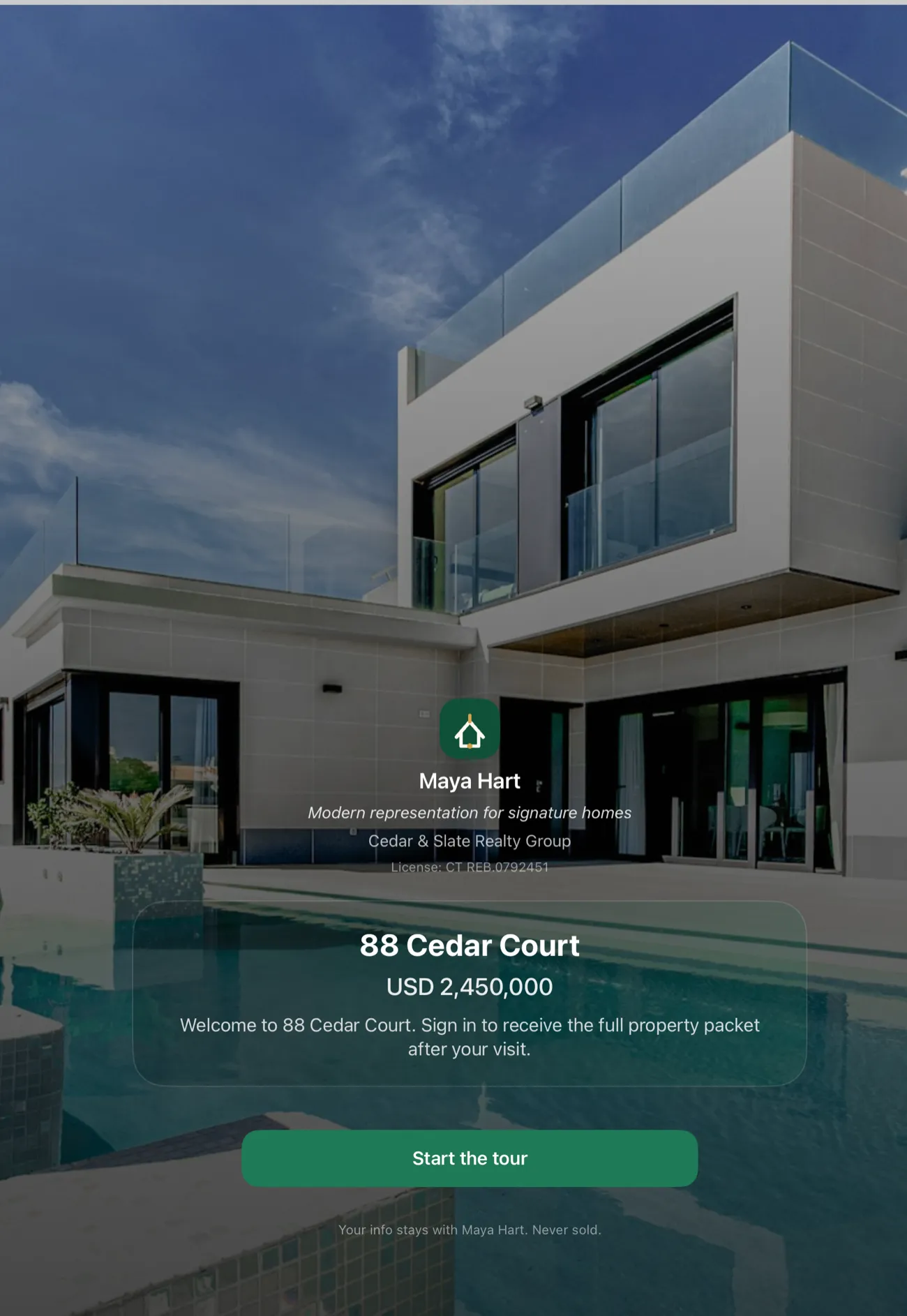
An open house is the cheapest pipeline a new agent has. You do not need a marketing budget, a book of past clients, or paid portal leads to run one. You need a listing to sit, a few hours on a Saturday, and a reliable way to keep the people who walk through the door. That last part is where the value lives, and it is also the part that breaks on paper. This page is the product side of that story: why OpenHouse is built for the newer agent whose whole plan is to turn open house traffic into a database, and how it keeps the capturing and the following up from slipping while you are still learning everything else about the job. If you want the how-to first, the guide to open houses for new agents walks through running the event itself.
Open houses are the pipeline you can afford
For a new agent the math is plain. Paid portal leads cost money you do not have yet, and referrals come from a sphere you have not built. An open house costs your time and a sign. The National Association of REALTORS, in its research and statistics, documents that a large share of buyers begin their search on their own before they commit to an agent, and an open house is one of the few places you meet those people face to face. Many of them walk in unrepresented, which is exactly the buyer a new agent can help and eventually represent.
The catch is that the pipeline only works if you keep the contact and act on it. A signed paper sheet that rides in your passenger seat until Wednesday is not a pipeline. It is a pile of names, half of them unreadable, and the good ones have already toured three more houses with someone else. The whole return on an open house is decided in the first day, by whether you captured the visitor cleanly and reached out while they still remember the kitchen.
Where the pipeline leaks on paper
Paper loses leads in ordinary, predictable ways. Handwriting you cannot read. A phone number with a transposed digit. The visitor who skips the email line because nobody is watching. The name that turns out to be fake because the sheet felt like a mailing list. And the biggest leak of all, the Monday re-typing chore that keeps getting postponed until the leads are cold.
A phone form fixes most of this by making the clean version the easy version. Required fields cannot be skipped. A digital keyboard is legible. And there is no separate data-entry step to forget, because the lead is already a record the moment the visitor taps submit. Part of your job at the door is telling a serious buyer from a neighbor comparing prices, and OpenHouse gives you a place to capture what you learn about each one instead of scribbling it in a margin you cannot read later.
Simple enough to run on your first Saturday
Your first few open houses are busy in your own head. You are rehearsing the property, watching the door, and trying not to look new. The sign-in process should ask nothing of you during that. Single-screen sign-in puts name, email, and phone on one screen with no scrolling and no account for the visitor to create. They fill three fields and they are done, without you standing over them. You can add a custom question when the listing calls for it, representation status or timeline, and it appears on the same screen instead of a second page.
To leave the iPad on the entry table without worrying about it, turn on kiosk mode and pair it with Apple's Guided Access. The tablet stays locked to the sign-in screen while you are across the room, so a visitor cannot wander into your photos or your messages, and you do not have to hover to keep it on task. For a new agent that means the front of the house runs itself while you do the part that actually wins clients: talking to people.
Qualifying so you know who to call first
A new agent's Saturday can produce twenty sign-ins, and not all twenty are worth a Sunday phone call. Some are neighbors. Some already have an agent. Some are a year from buying. Knowing which is which is the difference between a productive follow-up hour and a discouraging one, and it is hard to reconstruct from a name and a number on a sheet.
OpenHouse lets you add optional custom questions to the same single screen: whether the visitor is already working with an agent, their timeline, and how they plan to finance. Because the answers are captured as structured fields, not a handwritten note, you can see at a glance who is represented and off-market and who is the unrepresented buyer looking to move in ninety days, and your CRM can sort and segment them the same way once the leads land there. Your morning-after recap surfaces who still needs a call. For a new agent still learning to read a buyer, that structure means your limited follow-up time goes to the people most likely to become clients instead of the neighbor who was comparing prices.
The follow-up that turns a name into a client
Capturing the lead is the easy half. The half that decides whether a name becomes a client is the same-day follow-up, and it is the half a new agent, buried in everything else, is most likely to put off. The buyer who signed in at 2pm should hear from you that evening, not Tuesday.
OpenHouse is built to close that gap before you leave the listing. Text Now and Email Now send the first touch from your own number and your own email, not a shared line, using templates that merge the visitor's name, the property, and the price, so the message reads like you wrote it. A morning-after recap then lists who still needs a call, so the follow-up does not depend on you remembering a name you wrote down the day before. The open house follow-up guide covers the timing and the wording, and once that first touch lands, the guide to converting open house leads covers what to do next. Doing the fast follow-up consistently is a habit that separates new agents who build a book from new agents who do not, and the app exists to make it the path of least resistance.
Your leads land in your CRM, even a free one
A new agent may not have picked a CRM yet, and OpenHouse does not force the decision. It sends open house leads natively to Follow Up Boss, HubSpot, BoldTrail (kvCORE), Lofty, and Sierra Interactive after each event, and HubSpot in particular has a free tier you can start on the same week you start taking floor time. If you use something else, or a plain spreadsheet, lead export to CRM also gives you CSV, vCard, and Apple Contacts in a tap. Nothing about the app assumes you have already bought a pipeline tool.
That is the honest boundary worth stating plainly: OpenHouse is not a CRM. It does not run drip campaigns, manage pipeline stages, or dial for you. It captures at the door, qualifies the visitor, and hands the lead off clean. The long nurture belongs in whatever system you settle on, and because your leads are always exportable in an ordinary format, changing that system later never means untangling a proprietary pipe.
Nobody standing in the middle of your first contact
As a new agent, your entire value proposition is the relationship you build directly with the buyer. That makes it worth knowing what a free sign-in app costs you underneath the price. Curb Hero is genuinely well-built and popular, and it is free because it runs on lender co-marketing. Its own help documentation explains that a default lender can be assigned to your listings and that a visitor who opts into mortgage questions has their information shared with that lender. If a lender partnership is how you plan to work, that is a feature. If you are trying to be the person a first-time buyer trusts, having a third party in the middle of your first contact is a cost you may not want.
OpenHouse takes the other side. Private lead capture keeps the visitor data on your device by default, with no lender on the form and nothing sold. Cloud sync is opt-in, not the price of admission. The full data-ownership story is in who sees your open house data, but the short version is that the people you meet at the door are your contacts, not a vendor's marketing list.
It works where the listing is, with no Wi-Fi
New agents get handed the listings nobody else wants to sit: the vacant house across town, the rural property, the unit in the building with the locked network. Those are exactly the places venue Wi-Fi fails. Offline lead capture runs every sign-in on the device itself, with zero network calls during the event, so a dead zone changes nothing. There is no sync bar to watch and no moment where a visitor stands at the table while the app tries to reach a server. When you are the only person on site and still building your confidence, the last thing you want is connectivity turning into a problem you have to solve in front of a buyer.
Priced so your first leads are never held hostage
OpenHouse is 9.99 dollars per month or 79.99 dollars per year, with a one-month free trial. For a new agent whose income is lumpy, the part that matters most is what happens if money gets tight and the subscription lapses. It does not lock your data behind a paywall. The app drops to a read-only mode where every lead you captured stays visible and exportable, as CSV, PDF, vCard, or straight to Apple Contacts, for free. Your first hard-won contacts are never held hostage by a billing cycle, which is the reassurance you need before you put a tool at the front door of a business you are still getting off the ground.
This is also why the honest offer is a trial plus that safety net, not a permanent free tier. The app is a paid product, but it is priced so that one recovered client, a single buyer you would have lost to an unreadable sheet, pays for years of it.
Start with the playbook, then run one
The product side is straightforward: capture cleanly on one screen, follow up the same day from your own number, keep the data yours, and send it wherever you run your pipeline. The habit side is where new agents win or lose, and the guide to open houses for new agents is the playbook for running the event well, from setup to the questions you ask at the door. Pair that with the follow-up guide and you have both halves of the cheapest pipeline you have access to.
If you are early in your career and open houses are the plan, OpenHouse is built to make sure the leads you meet on Saturday are still in your database, and still hearing from you, on Sunday. That, more than anything else you will spend money on this year, is what turns floor time into a book of business.