
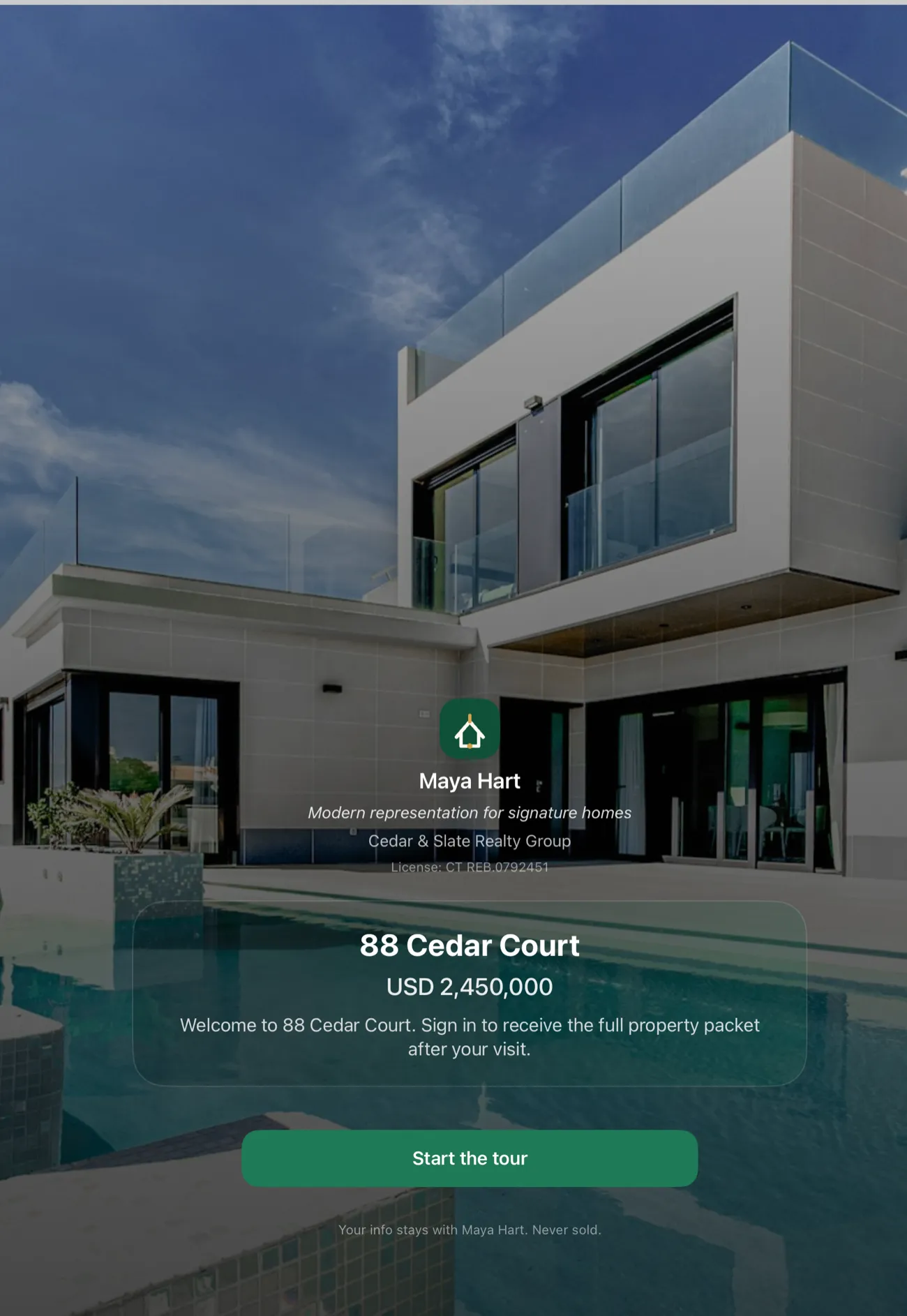
Open house app for solo agents is a search with a specific person behind it: the agent who sets up the listing, works the door, answers buyer questions, and does the follow-up, all without a team to hand any of it to. Most real estate agents work exactly this way. The National Association of REALTORS documents in its research and statistics that the typical member is an independent contractor running their own book of business, not a salaried employee of a large team. A tool built for a five-person listing operation assumes staff you do not have. This page is about what a sign-in app needs to do when the whole operation is one person.
Working the door alone is the real constraint
At a team open house, one person greets, one person mans the sign-in table, and one person floats. As a solo agent you are all three at once, and the sign-in process is the part most likely to break under that load. You cannot babysit a six-column form and hold a real conversation about the primary bedroom at the same time. Every second you spend coaching a visitor through the tablet is a second you are not spending on the buyer who is actually ready to make an offer.
So the first requirement is not a feature. It is restraint. Single-screen sign-in captures name, email, and phone on one screen with no scrolling, no account creation, and no vendor branding on the form. A visitor fills three fields and is done, without you standing over them. You can add a custom question or two, representation status or timeline, when the listing calls for it, and they appear on the same screen rather than forcing a second page. The point is that the form runs itself, because when you are working alone, anything that needs your attention at the table is a cost.
Pair the iPad with Apple's Guided Access and the tablet stays locked to the sign-in screen while you are across the room. Visitors cannot wander into your photos or messages, and you do not have to hover to keep the device on task.
The follow-up a solo agent actually forgets
The lead capture is the easy half. The half that quietly costs solo agents the most is the same-day follow-up, because Sunday evening is when a one-person operation runs out of hours. The buyer who signed in at 2pm gets a first text on Tuesday, if at all, and by then they have been to three more houses.
OpenHouse is built to close that gap while you are still at the listing. Text Now and Email Now send the first touch from your own number and email, using templates that merge the visitor's name, the property, and the price, so the message reads like you wrote it rather than a mass send. A morning-after recap then surfaces who still needs a call, so the follow-up does not depend on you remembering a name you wrote down eighteen hours earlier. The open house follow-up guide covers the timing and the templates in more depth, and the guide to converting open house leads covers what to do after the first touch lands.
None of this requires a coordinator. It requires the app to make the fast follow-up the path of least resistance, which is the only kind of follow-up a solo agent reliably does.
Your leads go to your CRM, not a vendor's funnel
A solo agent's pipeline is their whole business, so where the leads land is not a small detail. OpenHouse sends open house leads into the CRM you already run: Follow Up Boss, HubSpot, BoldTrail, Lofty, and Sierra Interactive receive them on their own after each event, and lead export to CRM also covers CSV, vCard, and Apple Contacts for any other tool. You keep your pipeline; the app just fills it.
That matters more when you compare it to the free-app model. Curb Hero is genuinely well-built, popular, and free, and it funds that with lender co-marketing. Curb Hero's own help documentation explains that a default lender can be assigned to your listings and that a visitor who opts into mortgage questions has their information shared with that lender. If a lender partnership is central to how you work, that is a feature. If you are a solo agent whose value is the relationship you build directly with the buyer, having a third party in the middle of your first contact is a cost you may not want to pay. OpenHouse's private lead capture keeps the visitor data on your device, with no lender on the form and nothing sold.
It works where the listing is, with no Wi-Fi
Solo agents draw a lot of the listings nobody else wants to staff: the vacant house across town, the rural property, the unit in the building with the locked network. Those are exactly the places venue Wi-Fi fails. Offline lead capture runs every sign-in on the device itself, so a dead zone changes nothing about the flow. There is no sync bar to watch and no moment where a visitor is standing at the table while the app tries to reach a server. When you are the only person on site, the last thing you want is connectivity to become a problem you have to solve in front of a buyer.
Priced and structured for one person
OpenHouse is a paid subscription at 9.99 dollars per month or 79.99 dollars per year, with a one-month free trial and no per-seat pricing to reason about. One subscription covers your iPhone and your iPad. That structure exists because the product is aimed at the individual agent, not sold by the seat to brokerages.
The subscription terms are built to be safe for a solo business too. If it lapses, the app does not lock your data behind a paywall. It drops to a read-only mode where every lead you captured stays visible and exportable, as CSV, PDF, vCard, or straight to Apple Contacts, for free. Your visitor list is never held hostage by billing, which is the reassurance a one-person operation needs before it commits to a tool at the front door.
When paper is still enough, and when it is not
An honest page for solo agents has to say this: if you run a handful of low-traffic open houses a month and you reliably re-type the sheet the same day, a printed sign-in sheet can still do the job, and free templates are one download away. The app earns its place when the volume rises or the follow-up starts slipping: unreadable handwriting, skipped contact fields, and the Monday data-entry chore that keeps getting postponed until the leads have gone cold. That is the moment a solo agent loses clients they already met, and it is the moment a sign-in app stops being overhead and starts being the cheapest client-retention insurance you can buy.
If you are running open houses on your own and the follow-up is the part that keeps slipping, that is the problem OpenHouse was built to take off your plate.