
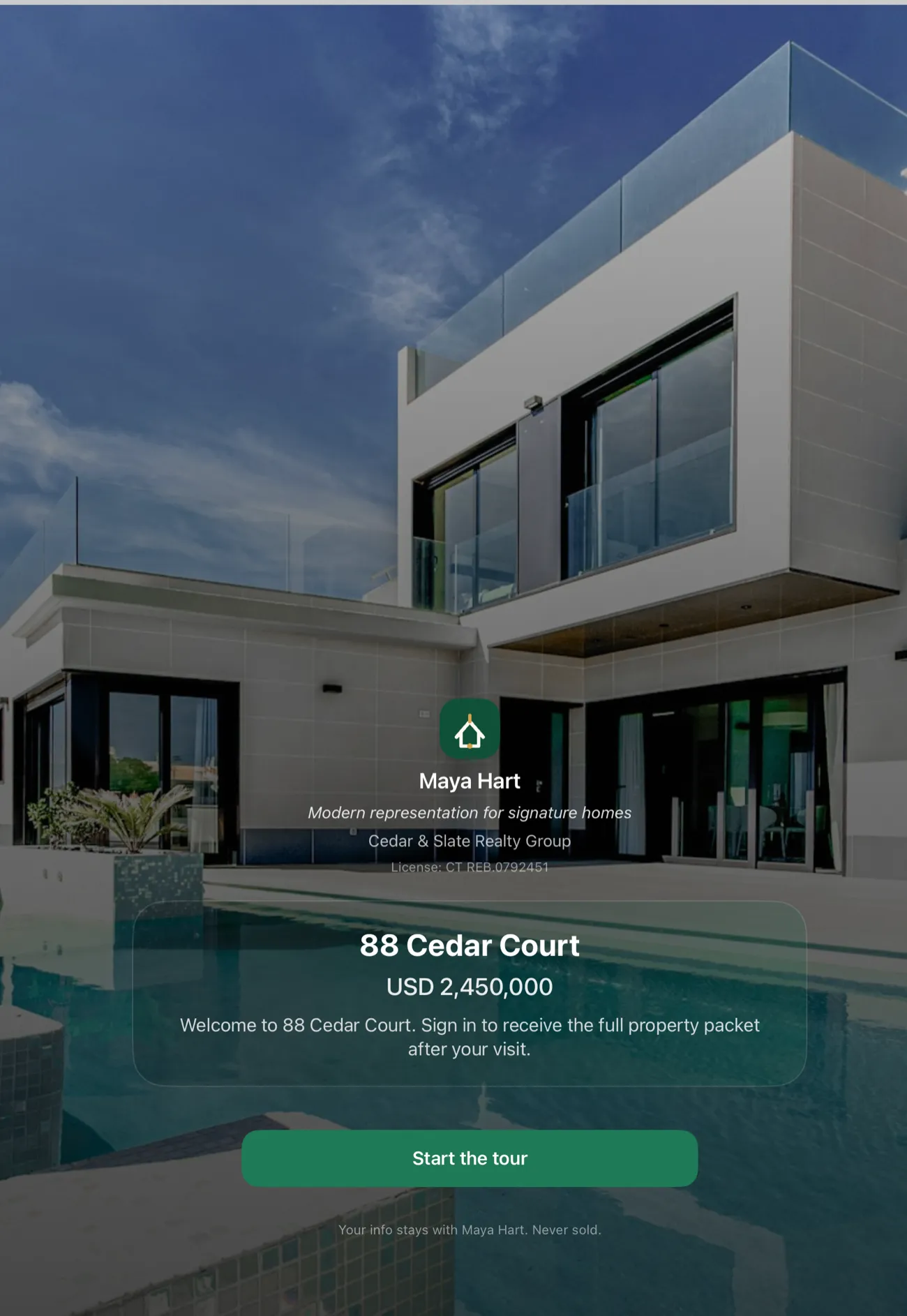
Open house app for brokerages is a different question than open house app for one agent, because at the office level the first thing on a broker-owner's mind is not the sign-in form. It is who ends up owning the leads. Across a full roster, every open house is a steady stream of buyer and seller contacts, and that stream is the brokerage's asset. OpenHouse is built so it stays inside the brokerage and its agents: there is no lender co-branding on the sign-in screen, capture runs on the device by default, and nothing is ever sold. On top of that, the office gets one shared workspace to see what every agent captured, per-seat billing that follows the roster as agents come and go, and a sign-in that looks like your brand instead of a vendor's. This page is about what a sign-in app has to do once it is running across many agents and teams at the same time.
Every open house lead stays inside the brokerage
At office scale the data-ownership question is not abstract. A brokerage running dozens of open houses a month is generating a large, current list of local buyers and sellers, and that list is worth more to the brokerage than to anyone else. The quiet risk with the free, lender-funded apps is that a third party gets attached to the list your agents build.
Curb Hero is well-built and free, and it pays for that with lender co-marketing. Curb Hero's own help documentation explains that a default lender can be assigned to your listings and that a visitor who opts into mortgage questions has their information shared with that lender. For an individual agent with a lender relationship, that can be a fair trade. For a brokerage, it means a lender sits in the middle of first contact on every listing across the roster, on a form that carries the office's name.
OpenHouse takes the opposite position. Private lead capture keeps visitor data on the device by default, with no lender on the form and nothing sold. When the brokerage turns on cloud sync so the office can see leads in one place, that sync stays inside the brokerage: it moves the data to the shared workspace your agents already belong to, not to an outside partner. The data-ownership architecture, and exactly who can see what, is spelled out in who sees your open house data. The short version for a broker-owner is that the answer is your agents and you, and no one else.
Most agents at a brokerage are independent contractors rather than employees, as the National Association of REALTORS documents in its research and statistics. The thing that keeps an independent roster coherent is the brand and the relationships, which is precisely what a lender-branded sign-in form chips away at. A sign-in that quietly routes first contact to a mortgage partner is not a small favor to a vendor. It is a piece of the brokerage's relationship with a buyer, handed to someone else at the exact moment it starts.
One workspace the whole office can see
The second job at office scale is visibility. Run a Saturday with eight agents across eight addresses and the broker-owner's question is simple: what came in, and who has it? OpenHouse answers it with a shared workspace. Invite your agents by email, each one runs their own listings, and every visitor they capture lands in one dashboard tagged with the address and the hosting agent. Nobody has to email a file around on Monday, and the broker can see the weekend's numbers without asking anyone.
For a brokerage, the point of that dashboard is oversight rather than day-to-day work. You are not trying to run every agent's follow-up from the corner office. You are trying to see that the leads are being captured cleanly, that they are landing where they should, and that no one is quietly losing a weekend of contacts to a bad process. The one dashboard makes that visible at a glance.
The mechanics of how leads stay separated by agent and by listing, so two agents working two addresses on the same day never see each other's visitors mixed together, are the same mechanics a single team relies on. Those are covered in depth on the real estate teams page. A brokerage is that shared-workspace model running across a bigger roster: the same event-scoped capture, the same one dashboard, more seats in it.
Per-seat billing that follows the roster
Brokerages have turnover, and a tool priced for a fixed headcount fights that. OpenHouse bills per seat: 9.99 dollars per month or 79.99 dollars per year for each agent, with the first month free. A seat belongs to an agent rather than to a device, and the same login works on that agent's iPhone, their iPad, and the web dashboard.
That structure is built for a roster that moves. Bring on three agents in the spring and add three seats in the spring. Lose two over the summer and drop two seats. What the brokerage pays tracks who is actually on the team, not a number the office committed to in January. There is no device count to reconcile and no per-lead fee stacking up underneath the subscription.
The lapse behavior matters at office scale too. If a subscription drops for any reason, the app moves to a data-safe read-only mode: every lead the brokerage captured stays viewable and exportable for free, as CSV, PDF, vCard, or straight to Apple Contacts. A billing gap never puts the office's visitor history behind a paywall, which is the reassurance a broker-owner needs before standardizing a whole roster on a single tool.
A sign-in screen that protects the brand
The seller-facing side of an open house is a brand moment, and most brokerages underrate how much the sign-in screen says about them. A visitor's first tap at your listing is on that form. Single-screen sign-in captures name, email, and phone on one screen with no scrolling, no account creation, and no vendor branding, so what a seller and a visitor see is a clean form tied to your listing rather than a page selling someone else's mortgage. You can add a custom question when a listing calls for it, representation status or timeline, and it appears on the same screen.
The device itself stays under control. Kiosk mode is PIN-locked, and it pairs with Apple's Guided Access so the iPad stays locked to the sign-in screen while the agent is across the room. Visitors cannot wander into the device, and the form looks the same, professional and unbranded, at every listing the brokerage staffs. For an office trying to keep a consistent presentation across agents who each have their own style, a sign-in that always looks the same is a small piece of brand discipline that costs nothing to enforce.
Offline reliability at every kind of listing
A brokerage covers everything: the downtown condo, the rural acreage, the new-construction lot before the ISP has turned on service, the high-rise where the elevator kills reception. Those are exactly the places venue Wi-Fi fails, and an app that needs a connection to save a sign-in is a liability at any one of them.
Offline lead capture runs every sign-in on the device itself, making zero network calls during the event. If an agent's iPad has no signal for the entire open house, every visitor is still captured, and the whole batch reaches the shared dashboard and the CRM once the device is back in range. For a brokerage sending agents to listings they have never set foot in, that removes the pre-event Wi-Fi question entirely. It also removes the worst failure mode: a busy Saturday where one agent's leads simply never saved because the listing had no service. Across a roster, that failure happens somewhere eventually, and offline-first capture is how the brokerage stops paying for it.
Leads reach whatever CRM each team runs
A brokerage rarely runs on one CRM. Different teams inside the office have their own tools and their own habits, and a sign-in app that forces everyone onto a single pipeline creates friction it does not need to. OpenHouse sends leads natively to Follow Up Boss, HubSpot, BoldTrail (kvCORE), Lofty, and Sierra Interactive on their own after each event, tagged with the property address. Lead export to CRM also covers CSV, vCard, and Apple Contacts for any other tool.
The native delivery is the convenience. Portability is the promise underneath it. Every lead is still a plain CSV or vCard when a team wants one, so a team that switches CRMs, or the brokerage that switches sign-in apps someday, is never untangling a proprietary pipe. Each team keeps the pipeline it already pays for, and OpenHouse just fills it. Setting up a connection is a one-time step per team, not a migration the whole office has to agree on.
Seller reports and disclosures at the office's standard
Two things a brokerage cares about that a solo agent can improvise are consistency and paper trail. OpenHouse produces both from the event data. The seller report is a clean PDF summarizing visitor count, the hot/warm/cold interest mix, the represented-versus-unrepresented share, and feedback themes, so every listing agent in the office hands the seller the same professional recap after an open house instead of a rough memory of the afternoon. When the agent who sat the open house is not the listing agent, that report is also the cleanest handoff of what happened.
On the compliance side, disclosure capture records buyer-agency and non-agency disclosures and a consent checkbox at sign-in. For a broker-owner, the value is that the disclosure happens the same way at every door, on every listing, without depending on each agent to remember. A consistent record captured at the point of contact is exactly the kind of thing a brokerage would rather have in place across the roster than reconstruct after the fact.
What OpenHouse is not
OpenHouse is not a CRM, and it does not try to become one for the brokerage. It does not run drip campaigns, manage pipeline stages, or dial. Those live in the systems your teams already run. What OpenHouse does is make the capture-and-handoff moment reliable at every listing, keep every lead straight by address and by agent, show the office one picture, and put the results in the CRM before anyone is back at the desk.
Two platform boundaries a broker-owner should know up front. The web dashboard runs in any browser, but offline sign-in at the door is iPad and iPhone; there is no Android native app. And OpenHouse is deliberately a capture-and-qualify tool, not a full lead-management platform, so if the office wants one system to also nurture, score, and route pipeline, the CRM is still where that happens. OpenHouse fills it and stays out of the way.
If your brokerage is running open houses across a roster and the parts that keep breaking are lead ownership, office-wide visibility, and a sign-in that quietly carries someone else's brand, that is the set of problems OpenHouse was built for. The first month is free. Put a few agents on it, run a real weekend, and check the one dashboard on Sunday night.
Frequently asked questions
Who owns the leads captured at our brokerage's open houses?
The brokerage and its agents do. OpenHouse puts no lender co-branding on the sign-in form, captures visitor data on the device by default, and never sells it. Every lead stays inside the brokerage and exports to your CRM, a CSV, a vCard, or Apple Contacts whenever you want. No third party is attached to the list your agents build at the door.
Can a broker-owner see every agent's open house leads in one place?
Yes. Invite your agents to one shared workspace and every visitor they capture lands in the same dashboard, tagged with the listing address and the agent who hosted. A broker-owner can see what came in across the whole roster without collecting spreadsheets from each agent on Monday. The team-level mechanics of how leads stay separated by agent and listing are covered on the real estate teams page.
How does billing work for a brokerage with a changing roster?
Billing is per seat: 9.99 dollars per month or 79.99 dollars per year for each agent, with the first month free. A seat belongs to an agent, not to an iPad, so add a seat when someone joins and drop it when they leave. What the brokerage pays follows the current roster instead of a contract negotiated at the start of the year.
Is there lender branding on the sign-in form?
No. There is no lender co-branding on the OpenHouse sign-in screen and no default lender assigned to your listings. The form carries your listing, not a mortgage ad, which is the difference between a sign-in that protects the brokerage brand and one that rents a corner of it to a partner.
What happens to our leads if we stop paying?
If a subscription lapses, the app drops to a data-safe read-only mode. Every lead the brokerage captured stays viewable and exportable for free, as CSV, PDF, vCard, or straight to Apple Contacts. The office's visitor history is never locked behind billing.
Which CRMs can our different teams send leads to?
OpenHouse sends leads to Follow Up Boss, HubSpot, BoldTrail (kvCORE), Lofty, and Sierra Interactive on their own after each event, tagged with the property address. If a team inside the brokerage runs a different CRM, every lead still exports as CSV, vCard, or Apple Contacts, so no team is forced onto a single tool.
Does OpenHouse work at listings with no Wi-Fi?
Yes. Sign-in and lead capture run entirely on the iPad or iPhone with zero network calls during the event, so a listing with no Wi-Fi and no cell signal still captures every visitor. Those leads reach the shared dashboard and the CRM once the device is back in range.
Is OpenHouse a CRM for the brokerage?
No. OpenHouse captures and qualifies visitors at the door, keeps them straight by listing and by agent, shows the office one picture, and hands every lead to the CRM the brokerage already uses. It does not run drip campaigns, manage pipeline stages, or dial. Those belong in your CRM.